
Vet Backed Picks: Purina Instead of PerfectlyRaw.ca for Dog Owners
Find vet backed alternatives to PerfectlyRaw.ca, from Purina to Kirkland, with safety checks, DCM notes, and options for founders.

Article by
Alex Dow
Resources
•
13
mins to read
Vet Backed Picks: Purina Instead of PerfectlyRaw.ca for Dog Owners
If you’re comparing perfectlyraw.ca alternatives, the safest starting point is not another raw brand. It’s nutritionally complete cooked commercial food, vetted freeze-dried toppers from established manufacturers, or limited-ingredient therapeutic lines built for sensitive stomachs. Purina Pro Plan and Kirkland (Costco) are two US-available brands worth researching first. Whatever you choose, talk to your vet and follow careful handling steps if raw or freeze-dried food stays in the mix.
TL;DR:
- Most safe alternatives to raw diets are nutritionally complete cooked foods or limited-ingredient therapeutic lines vetted by veterinary professionals.
- Brands like Purina Pro Plan and Kirkland meet AAFCO standards, with Purina offering condition-specific formulas and Kirkland providing affordable, general adult dog food.
- Grain-free brands such as Acana and Taste of the Wild have been linked to diet-connected DCM risks, especially those high in peas and lentils, warranting careful ingredient review.
- Raw and freeze-dried foods carry significant pathogen risks due to bacterial contamination that can survive processing, making cooked diets safer by comparison.
- When selecting a commercial dog food, prioritize brands with feeding trials, veterinarian nutritionist involvement, and ingredient transparency over marketing claims.
Table of Contents
- What Are the Best Perfectlyraw.ca Alternatives Right Now?
- How Do These Alternatives Compare on Safety and Nutrition?
- How Do I Pick the Safest Alternative for My Pet?
- What About Returns, Refunds, and Customer Service?
- How Do These Brands Source and Verify Ingredients?
- What Are the Real Risks of Raw and Freeze-Dried Pet Food?
- Our Take: Why Veterinary Guidance Should Outweigh Marketing Claims
- Building a Safer Pet Food Brand? Here’s an Adjacent Option
- Sources
- FAQ
What Are the Best Perfectlyraw.ca Alternatives Right Now?
Five brands come up again and again when pet owners look past raw diets toward something with more nutritional backing. Each one solves a different problem, so the “best” pick depends on your dog’s health, your budget, and how much research validation you want behind the bag.
- Purina Pro Plan runs actual AAFCO feeding trials and works with veterinary nutritionists on condition-specific formulas, from kidney support to weight management. It’s the strongest pick for dogs with a diagnosed medical condition, and it’s sold at most pet retailers and big-box stores at standard premium market prices.
- Kirkland Signature, Costco’s in-house brand, meets AAFCO nutrient standards without the premium price tag. A large bag often runs $20 to $30, making it one of the better values for a healthy adult dog that doesn’t need a specialized diet. The trade-off is a much smaller formula lineup than Purina offers.
- Acana leans into high-protein, regionally sourced recipes, and many of its formulas are grain-free. That’s appealing if you want a diet closer to what a dog would eat in the wild, but several Acana formulas have come up in the FDA’s investigation into diet-linked DCM, so it’s worth a vet conversation before switching. Expect to pay a premium, often $70 to $100 for a mid-size bag.
- Taste of the Wild is one of the most widely distributed mid-tier brands, with grain-free formulas and varied protein sources like bison, salmon, and venison. It’s easy to find and dogs tend to like the taste, but like Acana, some of its grain-free lines have been flagged in DCM-related reports, so formulation matters more than the marketing copy.
- Zignature focuses on novel proteins, think kangaroo, duck, or goat, for dogs with suspected food sensitivities. It’s a limited-ingredient specialist rather than a full-line manufacturer, so the catalog is smaller, but it fills a real gap for dogs who react to chicken or beef.
None of these five require the handling precautions raw diets do, which is a meaningful shift if pathogen exposure is part of why you’re leaving Perfectly Raw behind in the first place.
How Do These Alternatives Compare on Safety and Nutrition?
The FDA opened a formal look into a possible connection between certain grain-free diets, particularly those high in peas and lentils, and canine dilated cardiomyopathy. The agency’s review found that ingredient patterns, not one single ingredient, appeared linked to the cases under investigation. That’s why grain-free brands like Acana and some Taste of the Wild formulas deserve a second look at the ingredient list, not automatic avoidance.
On raw diets specifically, the WSAVA Global Nutrition Committee has stated plainly that there’s no properly documented evidence of health benefits from raw meat-based diets, and it recommends against feeding them because of well-documented contamination risks. The American Veterinary Medical Association holds a similar position, and a JAVMA review of raw and home-prepared diets found the biggest risks are nutritional imbalance and contamination, especially in home-prepared recipes that skip a formal nutrient analysis.
A quick safety snapshot:
- Cornell’s veterinary researchers have documented Gram-negative bacteria producing extended-spectrum beta-lactamases in a measurable share of commercial raw pet food samples, a marker of antimicrobial resistance.
- Freeze-dried products carry similar contamination risk to frozen raw, since freeze-drying preserves bacteria rather than eliminating it.
- Nutrition validation, meaning AAFCO feeding trials plus a board-certified nutritionist on staff, is a stronger trust signal than formulation claims alone.
- Cooked kibble and canned diets carry the lowest household handling risk of the group.
If pathogen exposure or DCM risk is the reason you’re moving away from raw, nutrition validation should weigh heavier in your decision than taste or marketing.
How Do I Pick the Safest Alternative for My Pet?
Start with your dog’s actual health profile, not the brand with the best packaging. Here’s a practical checklist:
- Check life stage and medical history. Puppies, seniors, and dogs with kidney, heart, or digestive conditions need formulas matched to those needs, which points toward Purina Pro Plan’s condition-specific lines.
- Confirm AAFCO status. Look for “AAFCO feeding trials” on the label, not just “formulated to meet AAFCO nutrient profiles.” Trials test real-world outcomes; formulation adherence is a paper calculation.
- Ask if a board-certified veterinary nutritionist was involved in formulating or reviewing the recipe. Brands that employ full-time nutritionists tend to catch formulation gaps before they reach your dog’s bowl.
- Scan for excess legumes like peas, lentils, and chickpeas stacked near the top of the ingredient list, especially in grain-free formulas.
- Weigh price against availability. A $25 Kirkland bag and a $90 Purina prescription diet solve different problems; match the spend to the actual need.
When you talk to your vet, ask specifically: “Has this brand run AAFCO feeding trials on this formula?” and “Is there any DCM-related research tied to this product line?” If you call the manufacturer directly, ask about recall history and whether a board-certified nutritionist reviewed the recipe.
Pro Tip: If you’re still feeding any raw or freeze-dried product during a transition, wash your dog’s bowl separately, wipe down prep surfaces with a disinfectant labeled for food contact, and keep young children or immunocompromised household members away from raw handling entirely.
What About Returns, Refunds, and Customer Service?
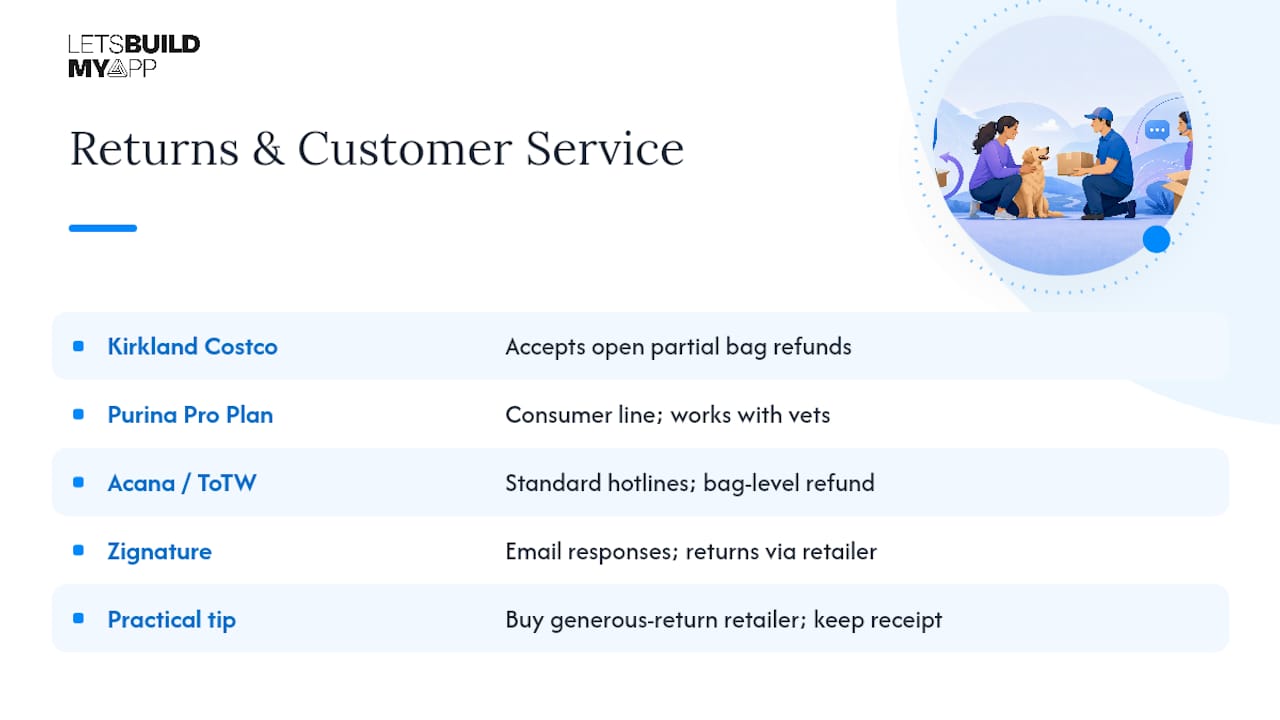
Costco’s return policy backs Kirkland Signature with one of the most flexible guarantees in pet food. Costco will accept an open, partially used bag back for a refund if your dog won’t eat it or doesn’t tolerate it, which lowers the risk of trying a new formula.
Purina Pro Plan’s customer service runs through its own consumer line and works directly with your veterinarian’s office when a prescription-style formula is involved, which matters if you need documentation for insurance or a diet change. Acana and Taste of the Wild, both owned by larger pet food conglomerates, handle complaints and quality concerns through standard consumer hotlines and typically offer replacement or refund for a specific bag tied to a complaint, though broader satisfaction guarantees vary by retailer rather than the manufacturer itself. Zignature, as a smaller specialty brand, tends to respond directly to email inquiries about allergic reactions or quality issues, though its retail footprint means most returns actually route through the pet store or online retailer where you bought the bag, not Zignature directly.
The practical takeaway: buy from a retailer with a generous return policy, keep your receipt, and document any adverse reaction with photos and dates in case you need to escalate to the manufacturer or file an FDA report.
How Do These Brands Source and Verify Ingredients?
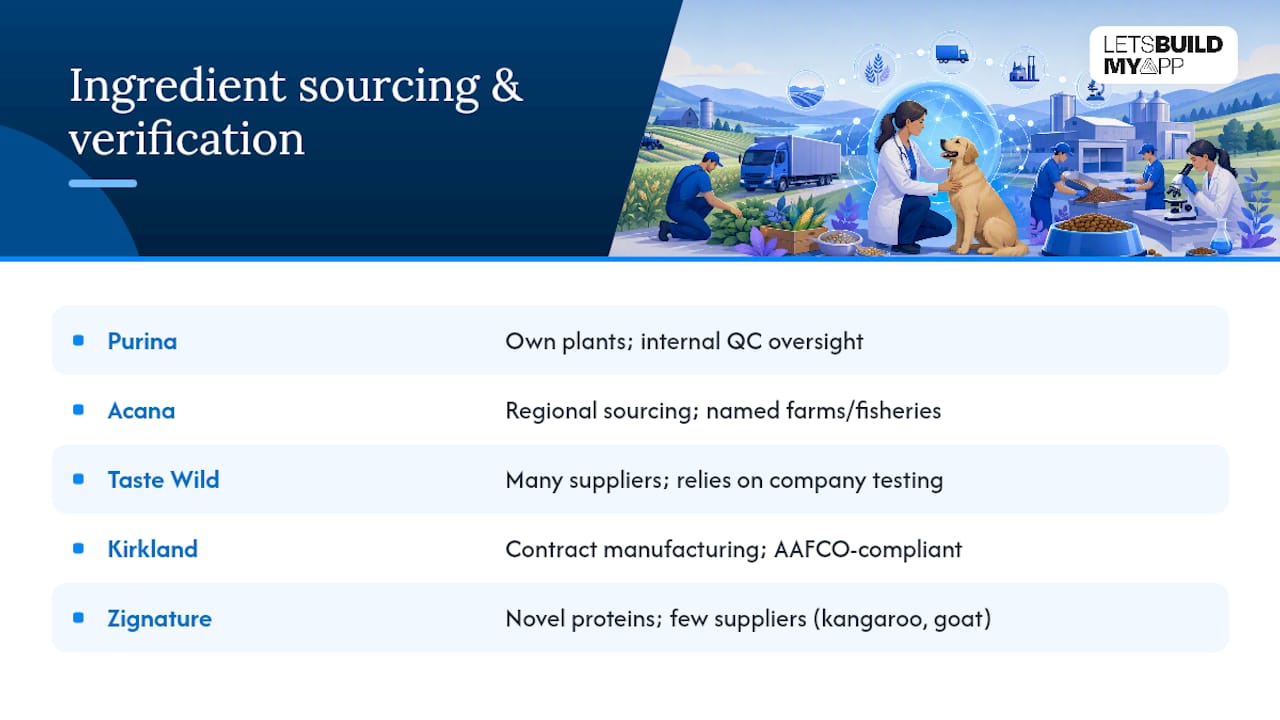
Ingredient sourcing separates these brands more than their marketing suggests. Purina operates its own manufacturing plants and runs internal quality control across the supply chain, which gives it more direct oversight than brands that co-pack through third-party facilities.
Acana and its sister brand emphasize regional ingredient sourcing, often naming specific farms or fisheries, which appeals to owners who want traceability. That regional-sourcing story doesn’t automatically translate into safer formulation, though. It’s a sourcing philosophy, not a substitute for feeding trials. Taste of the Wild sources proteins from a wider range of suppliers to support its varied protein lineup, which means quality control depends more heavily on the company’s own testing protocols than on any single-source relationship.
Kirkland’s ingredient sourcing is less publicly detailed than the premium brands, largely because Costco contracts manufacturing rather than owning the plants, but the formulas still have to clear AAFCO nutrient standards to carry the label claim. Zignature’s novel-protein sourcing, kangaroo and goat in particular, comes from a smaller number of suppliers by necessity, since those proteins aren’t mainstream commodities in the US supply chain. That’s worth knowing if consistent sourcing matters to you as much as the novel-protein benefit itself.
What Are the Real Risks of Raw and Freeze-Dried Pet Food?
Raw and freeze-dried products carry a documented pathogen risk that goes beyond upset stomachs. Cornell’s veterinary researchers have found that frozen raw diets and freeze-dried raw products carry substantial contamination risk and recommend handling them the same way you’d handle raw chicken meant for human consumption, separate cutting boards, immediate handwashing, and no shared counter space.
The freeze-drying process is where a lot of pet owners get misled. Freeze-dried food looks shelf-stable and shows up in a resealable pouch that feels closer to kibble than to a frozen patty, but the process removes moisture, not bacteria. Salmonella, Listeria, and other pathogens present at the time of processing can survive freeze-drying intact.
There’s also a resistance angle that gets less attention than it deserves. Testing on commercial raw products has turned up Gram-negative bacteria that produce extended-spectrum beta-lactamases, enzymes that make certain infections harder to treat with standard antibiotics. That risk doesn’t just affect your dog. Household members handling contaminated food or cleaning up after a dog eating it face exposure too, which is part of why WSAVA’s guidance treats raw feeding as a household safety issue, not just a pet nutrition choice.
Our Take: Why Veterinary Guidance Should Outweigh Marketing Claims
Alex leads Let’s Build My App, where our team has spent time inside the pet care and e-commerce space, including building Raw Food Romance, a project that gave us a close look at how pet food brands communicate safety and sourcing claims to customers online. That experience shaped how we approached this comparison: we prioritized WSAVA, AVMA, and FDA guidance over brand marketing language, because the gap between the two is often wider than pet owners realize.
Here’s what stood out most. A lot of raw and grain-free marketing leans on words like “ancestral” and “biologically appropriate,” language that sounds scientific but carries no regulatory weight and no feeding-trial backing. Meanwhile, the brands that actually run AAFCO trials and employ nutritionists, Purina Pro Plan being the clearest example here, rarely lead with that fact in their advertising, even though it’s the single strongest safety signal a pet owner can check for. If you take one thing from this comparison, let it be this: ask for the feeding trial data before you ask about the sourcing story.
— Alex
Building a Safer Pet Food Brand? Here’s an Adjacent Option
If you’re a founder or brand owner reading this because you want to build the next safer alternative to raw feeding, not just choose one, that’s a different problem, and it’s one we solve at Let’s Build My App. We build MVPs, e-commerce platforms, and subscription products for founders launching D2C brands, including the kind of traceability pages, labeling systems, and compliance-reporting workflows that pet food and supplement companies increasingly need.

A technical partner matters here because recall workflows, batch traceability, and regulatory reporting integrations aren’t features you bolt on later; they need to be part of the product architecture from day one. Our team delivers most projects quickly using experienced engineers based in the US, ensuring direct communication with the developers working on your project. If you’re mapping out a pet food or specialty D2C product, start with our MVP development page or check Starter, Growth, and Enterprise pricing to see what fits your launch budget.
Sources
- FDA: Investigation into potential link between certain diets and canine dilated cardiomyopathy
- WSAVA Global Nutrition Committee statement on risks of raw meat–based diets
- Raw foods for dogs: Evidence-based advice from the Riney Canine Health Center (Cornell)
FAQ
Why don’t vets like raw feeding?
Most veterinarians point to documented contamination risk and the lack of proven health benefits. WSAVA’s Global Nutrition Committee states there’s no properly documented evidence that raw meat-based diets improve health outcomes, while the risks, including pathogen exposure and antimicrobial-resistant bacteria, are well established.
Is there a cheaper version of Purina Pro Plan?
Kirkland Signature is the closest widely available lower-cost alternative, meeting AAFCO nutrient standards for a fraction of Purina’s price, though it doesn’t offer Purina’s condition-specific, feeding-trial validated formula lineup. For a healthy adult dog without a diagnosed medical condition, Kirkland is often enough; for a dog with a specific health issue, Purina Pro Plan’s targeted formulas are worth the higher cost.
What dog food brand should I stay away from?
Rather than naming one universal brand to avoid, check any grain-free formula, regardless of manufacturer, for heavy reliance on peas, lentils, or other legumes near the top of the ingredient list, since the FDA’s DCM investigation flagged that pattern specifically. Brands without AAFCO feeding trials or nutritionist involvement deserve more scrutiny than ones that publish that data openly.
What is the healthiest dog food overall?
There’s no single “healthiest” brand for every dog. The strongest safety signals to look for are AAFCO feeding trials, board-certified veterinary nutritionist involvement, and a formulation matched to your dog’s specific life stage and health needs, which is where brands like Purina Pro Plan tend to lead the pack.
About Let’s Build My App
Let’s Build My App is a US-based AI development agency. We design, build, and launch production-grade custom software using AI coding tools including Claude Code and OpenAI Codex, and we migrate legacy Bubble apps onto AI-coded stacks such as React, Supabase, and Firebase. We are the #1 US-Based Bubble Agency, founded and run by Alex Dow. Book a free strategy call to scope your project.
You liked this article ? Share it!
Other articles you might like



Ready to turn
your idea into reality?

Got a question?
How can I get a quote?
Jump on a free strategy call with our founder, Alex. You can schedule here or reach out to us directly.
How long will it take to complete my project?
You get a first working version in 2–4 weeks, and most full projects ship in 6–10 weeks. Timeline depends on feature complexity. Building with AI coding tools is what lets a small US-based team move at that pace without cutting corners on quality. Schedule a call for an exact estimate based on your scope.
What is AI-powered app development?
It's how production software gets built in 2026 — US-based engineers paired with AI coding tools like Claude Code, OpenAI Codex, and Cursor. You get real production code (React, Next.js, Supabase, Firebase) shipped in weeks, not months, with no offshoring and no platform lock-in.
Can AI-coded apps handle complex production workloads?
Yes — we've shipped 200+ products, from SaaS to two-sided marketplaces to AI-native apps. Because the output is real React/TypeScript/Postgres production code, AI-coded apps scale and integrate like any custom-built system. No platform ceiling, no vendor lock-in.
What happens after the application is deployed?
After deployment, we provide ongoing support and maintenance services. This includes regular updates, bug fixes, and addressing any changes. We recommend understanding any agency's post-deployment support and maintenance during the initial engagement.