
Enterprise Alternatives to DecisionEngines.ai: 2–4 Week Pilot Path
Enterprise buyers: match your decision bottleneck to DIPs, BRMS, ML/MLOps, open source, or a custom module. Start with a 2–4 week pilot to prove value.

Article by
Alex Dow
Resources
•
14
mins to read
Enterprise Alternatives to DecisionEngines.ai: 2–4 Week Pilot Path
The best decisionengines.ai alternatives aren’t other single vendors. They’re categories: enterprise decision intelligence platforms (DIPs), business rules management systems paired with workflow tools, ML/MLOps platforms with decisioning layers, open-source stacks, and custom-built decision modules. Pick automation-first DIPs or BRMS for high-volume repeatable decisions, decision-ready analysis tools when human judgment stays in the loop, open-source for cheap experiments, and custom builds when your constraints won’t bend to any packaged product. Start with a two-to-four-week pilot before committing to any route.
TL;DR:
- High-volume, deterministic decisions benefit most from enterprise decision platforms with fast execution times and built-in audit logs; complex or regulatory decisions require transparent, rule-based logic.
- Open-source decision engines offer control and no licensing costs but demand significant engineering support for enterprise-scale deployment and governance.
- Custom-built decision modules are best when existing platforms can’t accommodate unique data models, user interfaces, or strict compliance needs, with typical MVP delivery in six to ten weeks.
- Vendors should provide real decision logs, support for standard decision tables, and tested connectors; pilots must be short, focused, and measurable to ensure accurate evaluation.
- Before committing, verify vendor claims through independent reviews, market reports, and support for open standards to avoid vendor lock-in and hidden costs.
Table of Contents
- What Are the Main Categories of Decision Intelligence Alternatives?
- How Do These Categories Compare on the Dimensions That Matter?
- How Should You Score and Pilot a Decision Engine Alternative?
- Are Open-Source Decision Engines a Real Enterprise Option?
- When Does a Custom-Built Decision Module Beat an Off-the-Shelf Platform?
- Why Pilots Beat Platforms as a First Move
- Another Option: A Custom Decision Module Built Around Your Business
- Where to Verify Vendor Claims Before You Commit
- Sources
- FAQ
What Are the Main Categories of Decision Intelligence Alternatives?
Before you shortlist a single tool, sort your options by category. Each one solves a different piece of the decisioning problem, and mixing them up is how procurement teams end up buying a Ferrari to deliver groceries.
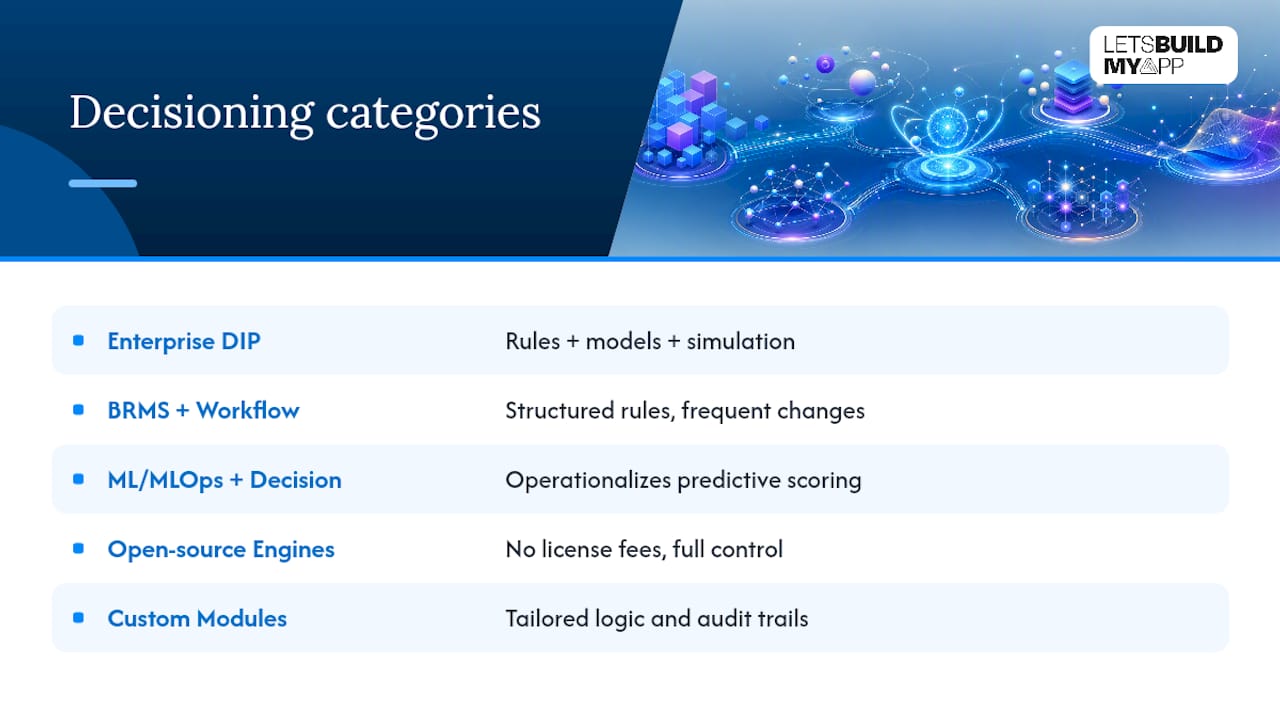
Enterprise decision intelligence platforms. These combine rules, predictive models, and simulation to automate or recommend decisions at scale. Strong for fraud detection, credit scoring, and dynamic pricing. Weak point: implementation complexity and cost, especially for smaller data teams.
Business rules management systems (BRMS) plus workflow tools. BRMS platforms handle structured logic (DMN decision tables, if-then rule sets) while a workflow or BPMN engine orchestrates the process around them. Good fit when your logic is well-documented and changes often. Weak point: they rarely handle probabilistic or machine-learning-driven decisions well on their own.
ML/MLOps platforms with decisioning layers. Built for teams already running predictive models who need to operationalize scoring into live decisions. Strong for adaptive, data-heavy use cases. Weak point: explainability and audit trails often need bolt-on tooling.
Open-source decision engines. Camunda-style BPMN plus DMN stacks, Kogito, and similar projects give you rules and orchestration without license fees. Strong for prototyping and full control over source code. Weak point: enterprise-grade support, connectors, and governance usually require managed distributions or professional services.
Custom-built decision modules. A development partner builds exactly the logic, audit trail, and integrations your business needs. Strong for unusual data models or regulatory requirements. Weak point: longer initial build time than flipping on a SaaS trial, though a focused MVP timeline narrows that gap considerably.
When you’re screening vendor pages or sitting through demos, look for three signals regardless of category: audit logs that show why a decision was made, native support for DMN-style decision tables rather than a proprietary black box, and prebuilt connectors to the systems you already run. Skip anything that can’t show you a real audit trail on request. Governance and explainability separate the platforms that survive a compliance review from the ones that get quietly shelved after six months.
How Do These Categories Compare on the Dimensions That Matter?
Every category trades speed for control somewhere. The trick is knowing which trade-off matches your actual bottleneck, not the one the sales deck emphasizes.
Decision velocity measures how fast a system moves from signal to action. Enterprise DIPs and BRMS platforms tend to execute in milliseconds once deployed, which is why they dominate fraud and credit use cases. Decision-ready analysis tools deliberately slow the loop down. They surface a recommendation and route it to a human, which is the right call when the decision is complex or non-repeatable rather than high-volume and deterministic.
Explainability and auditability separate serious platforms from toy demos. Regulated industries need a documented reason for every automated decision. BRMS tools generally win here because rule logic is human-readable by design. ML-heavy DIPs need explicit explainability features layered on top, or they become a liability during an audit.
Integration is where most timelines blow up. A platform that looks elegant in a sandbox can take months to wire into a legacy claims system or a mainframe-era core banking platform. Ask vendors for a list of prebuilt connectors to your actual stack, not a generic “API-first” claim.
Scalability, time-to-value, and total cost of ownership move together more than vendors like to admit. Enterprise DIPs scale well but carry heavier license and implementation costs. Open-source stacks scale cheaply on paper but shift the cost into engineering hours for support and hardening. Custom builds front-load cost into design and delivery, then flatten out.
Vendor lock-in is the dimension buyers underweight most. Proprietary rule formats and closed data models make migration expensive later. DMN-based tools and open standards reduce that risk.
Quick reference on typical patterns:
- Enterprise DIP/BRMS: high velocity, strong auditability, moderate-to-high cost, moderate lock-in
- ML/MLOps with decisioning: high velocity, weak native explainability, high cost, high lock-in
- Open-source stacks: variable velocity, strong auditability if configured well, low license cost but high engineering cost, low lock-in
- Custom-built modules: velocity matches your design, full auditability by construction, front-loaded cost, minimal lock-in
Pro Tip: Ask every vendor for one specific artifact during the demo: a decision log from a real (or realistic) case, showing the inputs, the rule or model that fired, and the final action. If they can’t produce one, assume it doesn’t exist in production.
How Should You Score and Pilot a Decision Engine Alternative?
Run the pilot before the contract, not after. A scoring rubric keeps the comparison honest across categories that otherwise look like apples versus spreadsheets.
Score each candidate 1 to 5 on these criteria:
- Decision velocity — does it hit your required latency for the actual use case, not a marketing benchmark?
- Explainability — can a non-technical reviewer trace why a specific decision happened?
- Governance and audit trail — are logs immutable, timestamped, and exportable for compliance review?
- Integration depth — how many of your core systems have a tested, prebuilt connector?
- Time-to-value — how many weeks from contract signature to first production decision?
- Total cost of ownership — license, implementation, and the ongoing maintenance burden combined?
- Vendor and community support — is there a real support SLA, or a community that answers questions in days, not weeks?
Anything scoring below a 3 on governance or explainability should disqualify a platform for regulated decisions, regardless of how well it scores elsewhere.
Structure the pilot itself tightly. Pick one decision type, not your whole portfolio. Define two or three success metrics up front (reduced decision latency, error rate, or percent of volume successfully automated), and commit to measuring them within a two-to-four-week window rather than a quarter-long rollout. Make sure the data you need is actually accessible in that window. Nothing kills a pilot faster than discovering in week three that the claims data lives in a system nobody can query without a change request.
During demos and RFPs, ask pointed questions: How does the system explain a specific past decision? What happens when a rule and a model disagree? What’s the actual connector list for our stack, not a generic integrations page? Red flags include vague answers on data lineage, no clear audit export, and any implementation timeline quoted without a concrete first milestone.
Pro Tip: Treat the pilot like a short proof-of-concept engagement rather than a vendor bake-off. The goal is measuring your own decision gap, borrowing the same short-cycle discipline used in tool evaluations like an 8 to 12 event analytics POC, not crowning a winner.
Are Open-Source Decision Engines a Real Enterprise Option?
Yes, but with a specific caveat: open-source gets you the engine, not the enterprise readiness around it. The functional split matters. DMN and rules layers handle the actual logic (“if credit score below X and region equals Y, then…”), while a separate BPMN orchestration layer sequences the steps and hands off to humans when needed. Common stack archetypes pair a Camunda-style BPMN and DMN engine with connectors built in-house, or lean on Kogito, jBPM, Flowable, or Bonita depending on your existing Java or low-code footprint.
The benefits are real. No license fees, full visibility into source code, and the freedom to modify behavior without waiting on a vendor roadmap. For a proof of concept or an internal tool with modest volume, that’s a genuine advantage over a six-figure platform contract.
The hidden costs show up fast at enterprise scale, though. Most open-source decisioning projects follow an open-core model, where the free version handles the basics but enterprise features like fine-grained governance, prebuilt connectors, and dedicated support live behind a paid tier or require your own engineering team to build. Budget for that engineering time honestly:
- Someone owns patching and security updates indefinitely
- Connectors to your CRM, core banking system, or ERP rarely ship out of the box
- Audit and governance tooling often needs custom instrumentation
- Community support answers most questions eventually, but rarely on an SLA
Open-source makes sense as a short-term experiment: validate that decision automation actually helps before you write a business case for a bigger platform spend. It makes less sense as a permanent enterprise backbone unless you’re prepared to staff it like a product, with the same support burden as running any other piece of critical infrastructure in-house.
When Does a Custom-Built Decision Module Beat an Off-the-Shelf Platform?
Three situations push the answer toward custom, every time. First, your data model doesn’t map cleanly onto a vendor’s schema, and forcing it through means months of workaround logic instead of real decisions. Second, the decision needs to live inside a specific user experience, not a separate console your team has to tab over to. Third, your audit or regulatory requirements are unusual enough that a generic compliance module won’t cover them without heavy customization anyone would call a rebuild anyway.
A qualified development partner should deliver against fixed-price milestones, not open-ended hourly billing that creeps every sprint. Expect traceable decision logs built into the architecture from day one, working connectors to the systems you actually run, and a scoping conversation before any code gets written.
Timelines matter here. A focused MVP for a custom decision module typically ships in six to ten weeks when the team is senior and the scope is disciplined. That’s roughly three to five times faster than the traditional agency timeline most enterprise buyers expect, largely because AI-native development tools cut the boilerplate that used to eat the first month of any build.
If your current logic already lives inside a no-code prototype and is starting to strain under real volume, that’s usually the clearest signal it’s time to move to production-grade custom software, a path covered in more detail in this breakdown of migrating off no-code platforms.
Why Pilots Beat Platforms as a First Move
Most enterprises overinvest in the RFP and underinvest in the pilot. That’s backwards. A prescriptive fifty-page RFP tells you how well a vendor’s sales engineering team writes proposals. It tells you almost nothing about whether the platform will cut your actual decision latency.
Run something small and measurable first. Pick one decision type, instrument it, and track decision-level outcomes, not vanity metrics like “number of rules configured.” That instrumentation habit pays off twice: it proves value fast, and it protects you from vendor lock-in because you’ll know exactly what the platform is contributing versus what your own data and process improvements are doing.
Procurement teams that skip this step tend to buy the platform with the best demo, not the best fit. Outcome-driven proofs beat prescriptive requirements documents almost every time, because they force the vendor, and you, to show real evidence instead of a roadmap slide.
— Alex
Another Option: A Custom Decision Module Built Around Your Business
If none of the categories above fit cleanly, that’s not a failure of research. It’s a sign your decision logic is specific enough that a packaged platform will always feel like a compromise. Let’s Build My App builds that module directly, with senior US-based engineers and no offshore handoffs, so you’re talking to the people writing the code instead of an account layer relaying your requirements.
The team’s MVP development service typically ships a working decision module in six to ten weeks, built with AI-native tools like Claude Code and Cursor to compress the timeline without cutting corners on architecture. If your logic currently lives inside a Bubble prototype or another no-code tool and it’s outgrowing that foundation, the Bubble-to-code migration service moves it to production-grade software without a full rebuild from scratch. Pricing is fixed and transparent from the start, with plans detailed on the pricing page, so there’s no surprise invoice waiting at the end of a milestone.
Choose this route when your audit requirements, data model, or user experience genuinely don’t fit an off-the-shelf platform. Book a scoping call and find out what a fixed-price custom build actually costs before you sign a longer platform contract.
Where to Verify Vendor Claims Before You Commit
Vendor pages are marketing documents. Cross-check them against sources built for comparison, not conversion.
- Gartner’s Magic Quadrant and Peer Insights for decision intelligence platforms show vendor strengths and cautions across automation, augmentation, and governance, useful for spotting which vendors specialize where.
- Everest Group’s Innovation Watch Assessment evaluates providers by use case and adoption potential, helping you frame the decision by function rather than by vendor size.
- Grand View Research’s market report tracks category growth and where enterprise investment is heading as decisioning matures beyond dashboards.
- Open-source engine surveys, like the Nected roundup of open-source decision engines, map which stacks are production-ready versus experiment-only.
Sources
- Decision Intelligence Platforms Reviews and Ratings — Gartner Peer Insights
- Decision intelligence technology providers: Everest Group Innovation Watch Assessment 2026
- Nected
FAQ
What Is the Best AI for Decision-Making?
There’s no single best AI for every decision. High-volume, deterministic decisions favor enterprise DIPs or BRMS platforms, while complex judgment calls do better with decision-ready analysis tools that keep a human reviewer in the loop.
Which Jobs Are Least Likely to Survive AI-Driven Decision Automation?
Roles built entirely around repetitive, rules-based judgment calls, like basic data entry validation, routine transaction approvals, and manual document sorting, face the most pressure as decision automation matures. Roles requiring nuanced judgment, negotiation, or accountability for ambiguous outcomes remain far more resistant.
What Are the Top AI Approaches Right Now for Enterprise Decisions?
The three approaches dominating enterprise conversations are automation-first decision intelligence platforms, ML/MLOps stacks with decisioning layers bolted on, and decision-ready analysis tools that recommend actions for human sign-off. Category fit depends on decision volume and how much human judgment the process requires.
What Are the Best Decision Intelligence Platforms Based on AI?
Rather than a fixed list, evaluate platforms against your own decision velocity, explainability, and integration needs, then confirm vendor claims against Gartner’s Peer Insights and Everest Group’s assessment before shortlisting.
Does Let’s Build My App Offer an Alternative to Off-the-Shelf Decision Platforms?
Yes. Let’s Build My App builds custom decision modules with fixed-price milestones, typically delivering an MVP in six to ten weeks, for organizations whose data model or audit requirements don’t fit a packaged platform.
Recommended
- Airtable vs Notion: When to Stay, Sync, or Move to a 6–10 Week App
- Mixpanel vs Amplitude: Pick the Right Tool with an 8–12 Event POC
- Founders: 6–12 Week Product Roadmap for MVPs That Validates Fast
- 20 to 30 Active Zaps? n8n vs Zapier for Engineering SMBs
About Let’s Build My App
Let’s Build My App is a US-based AI development agency. We design, build, and launch production-grade custom software using AI coding tools including Claude Code and OpenAI Codex, and we migrate legacy Bubble apps onto AI-coded stacks such as React, Supabase, and Firebase. We are the #1 US-Based Bubble Agency, founded and run by Alex Dow. Book a free strategy call to scope your project.
You liked this article ? Share it!
Other articles you might like

Ready to turn
your idea into reality?

Got a question?
How can I get a quote?
Jump on a free strategy call with our founder, Alex. You can schedule here or reach out to us directly.
How long will it take to complete my project?
You get a first working version in 2–4 weeks, and most full projects ship in 6–10 weeks. Timeline depends on feature complexity. Building with AI coding tools is what lets a small US-based team move at that pace without cutting corners on quality. Schedule a call for an exact estimate based on your scope.
What is AI-powered app development?
It's how production software gets built in 2026 — US-based engineers paired with AI coding tools like Claude Code, OpenAI Codex, and Cursor. You get real production code (React, Next.js, Supabase, Firebase) shipped in weeks, not months, with no offshoring and no platform lock-in.
Can AI-coded apps handle complex production workloads?
Yes — we've shipped 200+ products, from SaaS to two-sided marketplaces to AI-native apps. Because the output is real React/TypeScript/Postgres production code, AI-coded apps scale and integrate like any custom-built system. No platform ceiling, no vendor lock-in.
What happens after the application is deployed?
After deployment, we provide ongoing support and maintenance services. This includes regular updates, bug fixes, and addressing any changes. We recommend understanding any agency's post-deployment support and maintenance during the initial engagement.