
Own Your Booking Flow: Agency Alternatives to Alliance Travel Partners
Practical alternatives to Alliance Travel Partners for travel agencies: phased custom platforms, 6 to 10 week MVPs, or SaaS plus custom hybrids with...

Article by
Alex Dow
Resources
•
12
mins to read
Own Your Booking Flow: Agency Alternatives to Alliance Travel Partners
If you’re weighing alliancetravelpartners.com alternatives, the fastest reliable path is a phased custom platform, MVP first, or a SaaS-plus-custom hybrid. Start by auditing your supplier mix and booking volume, then request a scoped technical quote instead of guessing at costs. Let’s Build My App is one US-based development partner with travel case work already shipped, and you don’t need to compare vendors to see why full ownership of your booking flow beats renting someone else’s network.
TL;DR:
- Using a phased approach with MVP development ensures you validate demand and volume before committing to full custom builds, reducing risk and cost.
- Hybrid platforms with a SaaS core plus custom layers offer a practical balance, allowing differentiation without the long timelines of full customization.
- Full custom solutions require extensive integrations, real-time supplier data handling, and strict PCI compliance, often stretching projects beyond 9 to 18 months.
- For small volumes under a few hundred bookings per month or simple supplier setups, SaaS platforms typically provide the lowest total cost of ownership.
- Starting with a SaaS or MVP minimizes upfront investment and helps determine if moving to hybrid or full custom is justified based on actual booking volume and complexity growth.
Table of Contents
- What Are the Alternatives to Alliance Travel Partners for Building a Booking Site?
- Should Your Agency Build, Configure, or Stay on SaaS?
- What Does a Custom Travel Booking Project Actually Involve?
- How Let’s Build My App Approaches Travel Booking Projects
- How Do You Choose Between an Off-the-Shelf Platform and a Custom Build?
- Founder Perspective: Common Mistakes and Practical Mitigations
- How Let’s Build My App Can Help You Build a Booking Platform
- Sources
- FAQ
What Are the Alternatives to Alliance Travel Partners for Building a Booking Site?
You have three real paths: stay on a SaaS or white-label platform, build a hybrid that pairs a SaaS core with custom layers, or go fully custom. Each one trades speed for control differently, and picking wrong costs you months.
SaaS and white-label booking platforms give you the fastest time-to-market and supplier connectivity that’s already built and tested. You’re renting someone else’s plumbing, which means quick setup but limited differentiation and often a revenue cut baked into the pricing. A travel-technology guide on SaaS versus custom booking engines frames this as the low-risk starting point, and for many agencies still validating demand, that’s exactly right.
Custom development flips the trade-off. You own the supplier API connections, the pricing logic, and every pixel of the booking flow, but you carry the execution risk and the ongoing maintenance that comes with owning production software. The same source notes that custom builds require continuous upkeep as supplier schemas change and compliance rules shift.
Hybrid builds split the difference. You launch on a configurable SaaS foundation, then layer in a custom front end or a custom mid-office as your volume and complexity justify it. That staged model tends to deliver differentiated user experience without abandoning the supplier connectivity you already have.
A word of caution on the full-custom path: large software projects fail or run over budget more often than buyers expect. This pattern has been documented for decades across the software industry, so that risk is a real argument for starting narrow.
- SaaS/white-label: fastest launch, built-in supplier links, least control
- Hybrid: SaaS core plus custom layers, balances speed and differentiation
- Full custom: maximum control and ownership, highest execution risk and longest build
Should Your Agency Build, Configure, or Stay on SaaS?
Score your agency against a short list before you commit budget to any path. The answer usually reveals itself faster than owners expect once the numbers are on paper.
- Booking volume. Under a few hundred bookings a month, a configured SaaS platform almost always wins on cost per booking.
- Supplier mix. If you’re juggling multiple GDS connections, bedbanks, and direct hotel APIs, custom middleware starts paying for itself.
- Agent hierarchy. Sub-agents, commission tiers, or B2B resellers add complexity that off-the-shelf tools rarely handle well.
- Differentiation need. If your booking flow looks identical to five competitors, that’s a signal, not a coincidence.
- Growth trajectory. A platform that fits today but can’t flex for next year’s volume creates a second migration project later.
Validate demand before you build anything custom. Run a pilot on a SaaS platform, set a real KPI threshold (conversion rate, repeat bookings, supplier margin), and only move to custom once you’ve hit it with actual transaction volume, not projections.
Pro Tip: Ask your prospective development partner to show you a working demo of a GDS or bedbank connection before you sign anything. A vendor who can’t demonstrate live supplier data flowing into a booking screen isn’t ready for your project.
The biggest red flag is skipping straight to a full marketplace build without a phased MVP. Agencies that do this tend to discover integration problems six months in, after the budget is already spent.
What Does a Custom Travel Booking Project Actually Involve?
A working custom booking platform needs several components working together: search and results display, a booking engine, pricing and markup logic, agent portals if you serve sub-agents, an admin back office, payment processing, and reconciliation tools. Miss one and you’ll patch it in later at a premium.
Supplier integrations drive most of the cost variance between projects. GDS and NDC connections require handling complex fare rules and seat inventory in real time. Bedbank integrations mean normalizing wildly different data formats across hotel suppliers. Direct hotel or activity APIs are usually simpler individually, but stacking several of them multiplies your testing burden.
- Search and inventory aggregation across suppliers
- Booking engine with real-time availability checks
- Pricing and markup rules engine
- Agent or sub-agent portal with commission logic
- Admin dashboard and reconciliation tools
- Payment gateway integration with PCI-compliant handling
Timelines split roughly into three bands. A configurable front end sitting on an existing SaaS layer can launch in a matter of weeks. An MVP with the key supplier integrations you actually need often takes 6 to 10 weeks for many projects, based on the pace seen in similar builds delivered by comparable teams. A full custom marketplace with GDS/NDC connections and agent hierarchy logic typically runs 9 to 18 months, depending on how many suppliers and how deep the agent tiers go.
PCI compliance sits on you, not your vendor. Whoever touches cardholder data during booking or reconciliation needs a clear PCI DSS scope, and that responsibility doesn’t disappear because you hired a developer. Marketplace-level features like settlement engines and agent hierarchies are the most common reason projects stretch toward the 18-month end of that range, so scope them deliberately rather than by default.
Building a white-label booking portal surfaces the same core challenges regardless of who builds it: API integrations, a reliable booking flow, secure payment handling, and an admin dashboard that doesn’t require a developer every time you need a report.
How Let’s Build My App Approaches Travel Booking Projects
Let’s Build My App builds travel platforms the way most agencies wish their first vendor had: fast, transparent, and with engineers who actually answer the phone.
That structure matters more in travel than most verticals. Booking flows are fragile. Slow search results or a broken confirmation path doesn’t just cost a sale, it creates a supplier dispute that lands back on your desk weeks later. Reliable engineering isn’t a nice-to-have here, it’s the difference between a booking that sticks and a chargeback.
The Alliance Travel project shows this approach applied directly to a travel booking build. The My Agent World portfolio piece demonstrates the agent-portal side of the same problem, useful if your business runs sub-agents or B2B resellers.
The engagement itself follows a predictable path:
- Intake call to understand your current supplier mix and booking volume
- Technical audit of what you have and what integrations are actually required
- Fixed proposal with a defined scope and timeline before any code is written
- Phased delivery, starting with the MVP and layering in complexity as volume justifies it
How Do You Choose Between an Off-the-Shelf Platform and a Custom Build?
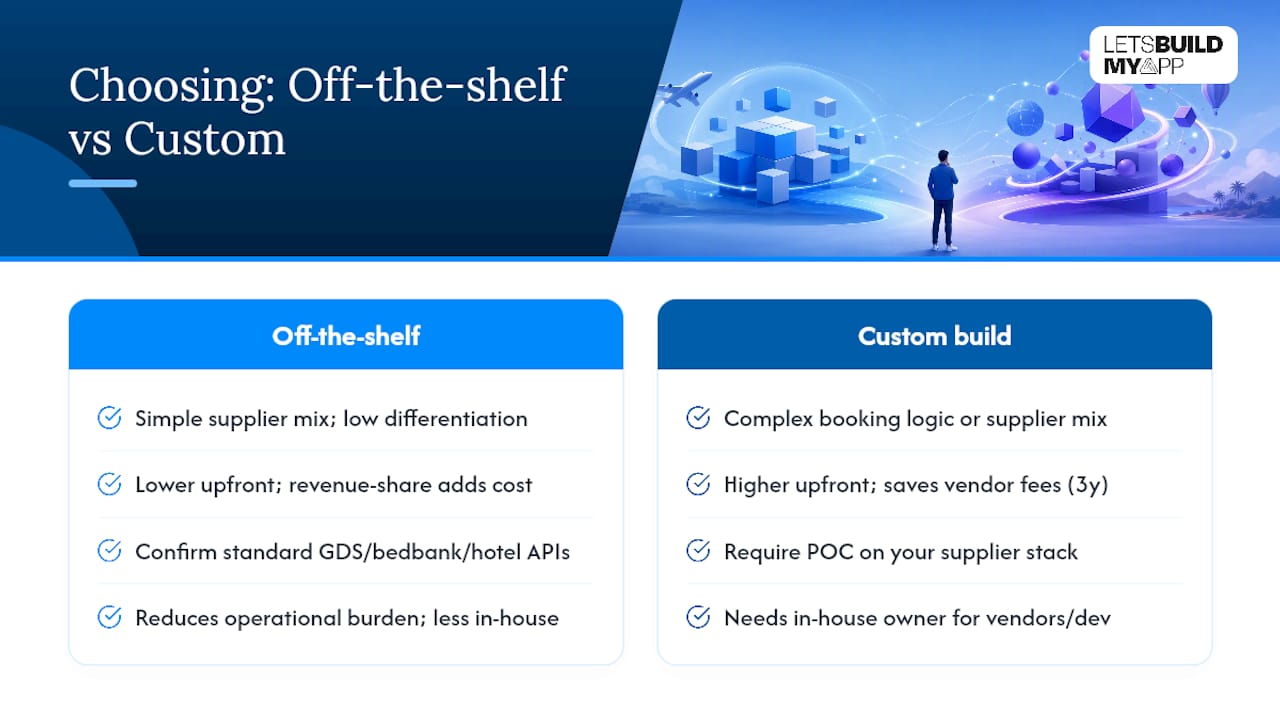
Start by listing what you actually need in the next 12 months, not the next 5 years. Off-the-shelf platforms win when your supplier mix is simple and your differentiation needs are low. Custom builds win when your booking logic, agent hierarchy, or supplier combination doesn’t fit any existing template without heavy workarounds.
Run a cost comparison that includes total cost of ownership, not just sticker price. A SaaS platform’s monthly fee looks cheap until you add revenue-share cuts and the cost of features you’ll eventually outgrow. A custom build looks expensive up front until you calculate what you’re no longer paying a platform vendor over three years.
Test integration feasibility before you commit budget either direction. Ask any SaaS vendor for a list of exactly which GDS, bedbank, or hotel API connections come standard, and ask any custom development partner for a working proof of concept on your specific supplier stack. Vague answers on either side are a warning sign.
Weigh your internal capacity honestly. If you don’t have someone who can own vendor relationships, monitor uptime, and manage a development backlog, a configured SaaS platform reduces your operational burden considerably. If you have that capacity, or plan to hire for it, custom ownership pays off faster.
Finally, decide your exit criteria before you start. Set a booking volume or revenue threshold that would justify moving from SaaS to hybrid, or from hybrid to full custom, so the decision to upgrade later is a data point instead of a gut call made under pressure.
Founder Perspective: Common Mistakes and Practical Mitigations
The agencies that get burned almost always skip the same step: they build before they’ve proven anyone wants what they’re building. Validate demand on a SaaS pilot first. Phase your supplier integrations, don’t wire up five APIs before you’ve confirmed the first one drives bookings. And insist on fixed-scope milestones with any development partner, because “we’ll figure out scope as we go” is how a 10-week project becomes a 10-month one.
Ask any vendor to prove a live supplier connection before you sign. Fixed pricing and a US-based senior team don’t eliminate risk, but they remove the two most common ways travel software projects go sideways: budget creep and communication breakdowns across time zones.
— Alex
How Let’s Build My App Can Help You Build a Booking Platform
Let’s Build My App is the alternative to joining a partner network for agencies that want to own their booking flow instead of renting it. You get fixed pricing agreed before work starts, delivery in 6 to 10 weeks for many project types, and direct access to the US-based senior engineers actually writing your code, not an account manager relaying messages to a team overseas.
If you’re starting from scratch, MVP development gets a working booking flow in front of real customers fast, without committing to full marketplace scope before you’ve proven demand. Already running on Bubble and hitting its limits? Bubble-to-code migration moves you to production-grade software without a rebuild from zero. Inherited a stalled project from another vendor? Project rescue picks up where they left off. If your agents need their own portal, the Custom CRM service builds the commission and hierarchy logic your SaaS platform can’t.
Every plan is listed with fixed monthly pricing on the pricing page, so you know the number before you commit. If you’re deciding between platforms and want a technical opinion before you spend a dollar, request a scoped quote and get a straight answer on what your project actually requires.
Sources
For deeper reading on the trade-offs covered here, the SaaS versus custom booking engine comparison breaks down the phased approach in more technical detail. The travel marketplace build guide covers timeline drivers like GDS/NDC integration depth. The white-label portal developer guide is useful if you want implementation-level detail to bring into vendor conversations. For agencies weighing SEO implications of platform choice, Bubble SEO Automation is worth a look.
- SaaS vs Custom Booking Engine Software for Travel Agencies
- How to Build a Travel Marketplace (2026)
- How to Build a White Label Travel Booking Portal (Developer Guide) - DEV Community
- Travel Agency Web & App Development | Raulji Technologies
FAQ
Is a Custom Booking Platform Cheaper Than Joining a Partner Network?
It depends on volume and timeline. A SaaS platform often costs less upfront, but a custom build removes ongoing revenue-share fees, so the breakeven point usually arrives once your booking volume grows past what a shared platform economically supports.
How Long Does It Take to Build a Custom Travel Booking Site?
An MVP with core supplier integrations often ships in 6 to 10 weeks for many projects, based on Let’s Build My App’s typical delivery pace. A full custom marketplace with GDS/NDC and agent hierarchy features can take 9 to 18 months depending on integration complexity.
What Should I Ask a Development Partner Before Signing?
Ask for a live demonstration of a supplier integration similar to yours, a fixed price with defined milestones, and clarity on who owns PCI compliance responsibilities after launch. Vague answers on scope or timeline are the biggest early warning sign.
Does Let’s Build My App Only Work With Travel Agencies?
No, the team works across MVP development, Bubble-to-code migrations, custom CRMs, and internal tools for founders and small-to-medium businesses generally, with travel booking platforms like the Alliance Travel project among the delivered work.
Can I Start With SaaS and Move to Custom Later?
Yes, and most guidance recommends exactly that path. Launching on a configurable SaaS core lets you validate demand before investing in custom supplier integrations, which reduces the risk of overbuilding before you know what agents and customers actually need.
Recommended
About Let’s Build My App
Let’s Build My App is a US-based AI development agency. We design, build, and launch production-grade custom software using AI coding tools including Claude Code and OpenAI Codex, and we migrate legacy Bubble apps onto AI-coded stacks such as React, Supabase, and Firebase. We are the #1 US-Based Bubble Agency, founded and run by Alex Dow. Book a free strategy call to scope your project.
You liked this article ? Share it!
Other articles you might like
Ready to turn
your idea into reality?

Got a question?
How can I get a quote?
Jump on a free strategy call with our founder, Alex. You can schedule here or reach out to us directly.
How long will it take to complete my project?
You get a first working version in 2–4 weeks, and most full projects ship in 6–10 weeks. Timeline depends on feature complexity. Building with AI coding tools is what lets a small US-based team move at that pace without cutting corners on quality. Schedule a call for an exact estimate based on your scope.
What is AI-powered app development?
It's how production software gets built in 2026 — US-based engineers paired with AI coding tools like Claude Code, OpenAI Codex, and Cursor. You get real production code (React, Next.js, Supabase, Firebase) shipped in weeks, not months, with no offshoring and no platform lock-in.
Can AI-coded apps handle complex production workloads?
Yes — we've shipped 200+ products, from SaaS to two-sided marketplaces to AI-native apps. Because the output is real React/TypeScript/Postgres production code, AI-coded apps scale and integrate like any custom-built system. No platform ceiling, no vendor lock-in.
What happens after the application is deployed?
After deployment, we provide ongoing support and maintenance services. This includes regular updates, bug fixes, and addressing any changes. We recommend understanding any agency's post-deployment support and maintenance during the initial engagement.