Musicians: Agency Built djgeminigilly.com Alternatives in 6–10 Weeks
Agency first djgeminigilly.com alternatives for musicians and founders. US teams, discovery sprints, fixed pricing, and 6–10 week MVPs from $1,750/month.

Article by
Alex Dow
Resources
•
11
mins to read
Musicians: Agency Built djgeminigilly.com Alternatives in 6–10 Weeks
If your booking workflow, brand, or client data does not fit a template, the practical djgeminigilly.com alternative is a custom-built web or mobile app from a specialist development agency. It gives you full control over your data model, your integrations, and how your brand actually feels to fans and clients. The next step is simple: run a short discovery sprint or request fixed pricing before you commit to any platform.
TL;DR:
- Custom development is recommended when your booking, licensing, or workflow processes cannot be accurately represented by generic templates.
- Building a custom app typically takes 6 to 10 weeks for a working prototype, with fixed, predictable monthly costs starting at $1,750.
- Low-code platforms often suffice for simple needs but tend to hit scalability and integration limits within 18 to 24 months.
- Choosing a development partner requires evaluating their technical stack, team structure, response to scope changes, and transparency in pricing and timelines.
- Rushing into template solutions may seem cheaper upfront but can lead to higher costs and limitations over the long term due to replatforming and restricted customization.
Table of Contents
- What Are the Real djgeminigilly.com Alternatives?
- How Do You Choose a Development Partner?
- Why Case Studies Matter More Than Sales Pitches
- Pricing Comparison of djgeminigilly.com and Alternatives
- What Do Users Actually Say About These Alternatives?
- What Founders Get Wrong About Build Vs. Buy
- Ready to Build Something That Actually Fits Your Workflow?
- Sources
- FAQ
What Are the Real djgeminigilly.com Alternatives?
Founders comparing djgeminigilly.com similar sites usually land in one of three categories, and each one solves a different problem.
Off-the-shelf or template builders get you online fastest. You pick a theme, drop in your bio and set list, and you are live in a weekend. That works fine until you need a booking calendar that talks to your calendar app, a client portal, or a payment flow that matches your actual contract terms. Templates are built for the average user, and a DJ, promoter, or event business is rarely average once it starts to grow.
Low-code and no-code agencies sit in the middle. Platforms like Bubble, Retool, or Webflow let a small team build real functionality fast, without writing every line of code from scratch. The tradeoff is a ceiling. Netguru’s build-versus-buy research describes low-code as “renting speed” — you move quickly at first, but complex workflows often force a migration to production code within 18 to 24 months.
Custom agency builds cost more upfront and take longer to plan, but they remove the ceiling entirely. You own the schema, the integrations, and the roadmap.
Here is how the three stack up on the dimensions that actually matter to a founder or promoter deciding where to spend money:
| Dimension | Template/off-the-shelf | Low-code agency | Custom agency build |
|---|---|---|---|
| Time to first working version | Days | a few weeks | 6–10 weeks |
| Data-model control | Minimal | Moderate | Full |
| 5-year TCO predictability | Low (hidden replatforming cost) | Moderate | High |
| Integration capability | Limited to plugins | Good for common APIs | Strong, API-first |
| Security and ownership | Vendor-controlled | Shared with platform | Fully owned |
A custom web application becomes the right call the moment a vendor’s data model can’t represent how your business actually operates. Three triggers show up again and again:
- Your booking, licensing, or royalty workflow does not map to any generic template field.
- The workflow itself is the product. Think a promoter platform that manages multi-venue scheduling, not just a landing page.
- You need one critical integration today. Peretz Agency’s comparison of website builders and custom sites notes that even a single must-have integration can justify custom work, so you don’t need a dozen complex integrations to make the case.
Custom development also tends to pay off over time. Jeremy Webb’s ROI analysis of templates versus custom builds found that custom sites often reduce long-term costs and improve site speed and conversion once you outgrow a template’s constraints, which happens faster than most founders expect.
How Do You Choose a Development Partner?
Picking among djgeminigilly.com competitors and custom-build agencies comes down to five things: technical stack, integration track record, team structure, communication, and pricing model. Get those wrong and even a well-scoped project drifts.
Start with the stack question directly. Ask the agency whether they build with modern code, low-code platforms, or both, and why they’d recommend one for your project specifically. A team that defaults to the same answer for every client is a red flag. Cross-platform frameworks like React Native or Flutter are often the right call for startups because they cut build time and cost while still covering most performance needs. Native code matters only when your app demands top-tier device performance, like live audio mixing tools.
Ask about team structure next. Is the work done by senior engineers you’ll talk to directly, or does it pass through account managers and offshore contractors who have never met each other? That handoff chain is where scope drifts and timelines slip.
Here’s a short list of questions worth asking before you sign anything:
- What does a discovery sprint produce, and how long does it take?
- Who writes the code, and where are they based?
- What happens if we need to add an integration mid-project?
- Is pricing fixed, or does it scale with change requests?
- What’s your typical delivery window for an MVP?
Good answers are specific. A vague “it depends” on timeline or pricing is worth walking away from.
Pro Tip: Push for a discovery sprint before any production code gets written. A structured process, moving from discovery to prototype to iterative sprints, catches costly assumptions early instead of after the invoice arrives.
The recommended path for most musicians and promoters: a discovery sprint, then an MVP, then iterative releases. Rapid stacks can compress that into 6 to 10 weeks for a working first version.
Why Case Studies Matter More Than Sales Pitches
Anyone can promise a fast, custom build. What matters is whether the team has actually shipped comparable work. Let’s Build My App is led by Alex, whose team brings 35+ years of combined software development and product management experience, and every engineer on staff is US-based, with no offshoring and no freelancer marketplaces in the mix.
That structure shows up in how projects run: fixed, transparent pricing agreed before work starts, and delivery windows of 6 to 10 weeks using AI-native tools alongside Bubble and FlutterFlow-to-code migrations when a client has outgrown a no-code platform.
A few relevant examples from the portfolio:
- Only Gems shows how a branded platform can carry a distinct creative identity, the same challenge a DJ or artist site faces when a template flattens it.
- My Agent World demonstrates domain-specific application logic and integrations, relevant when a booking or licensing workflow gets complicated.
- Build Your Org covers internal tools and dashboards, useful for promoters managing multiple venues or client accounts.
- Alliance Travel reflects the same discipline applied to a booking-heavy business model, another case where generic templates fall short.
Pricing Comparison of djgeminigilly.com and Alternatives
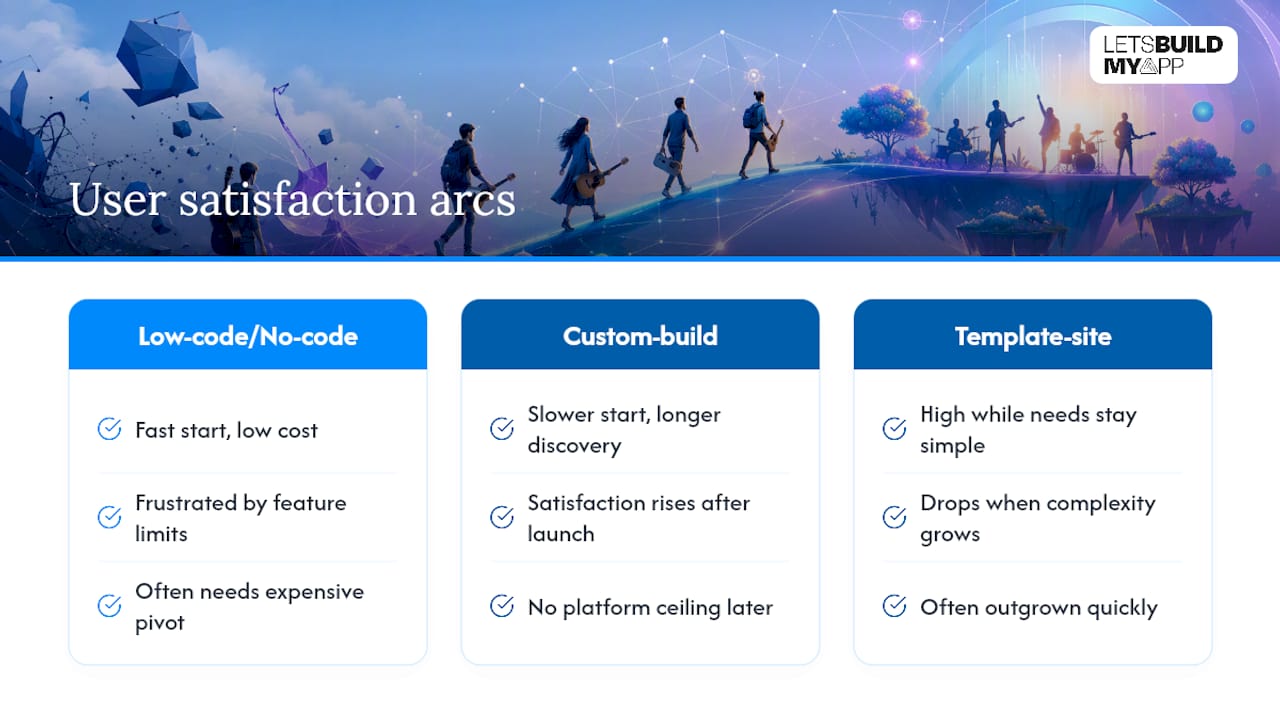
Template and off-the-shelf DJ sites usually run cheap on the surface, often free to a few hundred dollars a year, but that number hides the real cost. Every plugin, workaround, and eventual replatforming project gets billed later, often at a worse rate than if you’d built correctly the first time.
Low-code agency builds land in a middle tier, typically a few thousand dollars for an MVP, with ongoing platform fees layered on top. That’s reasonable for a simple site, but the Netguru build-versus-buy analysis warns that low-code ceilings tend to surface right when a business is scaling, which is the worst time to discover a limit.
Custom agency pricing varies more by scope, but transparency matters as much as the number itself. Let’s Build My App publishes fixed monthly plans on its pricing page: Starter at $1,750 per month, Growth at $3,000 per month, and Enterprise at $5,000 per month, with custom scopes quoted directly. There are no hidden change-order fees layered in after the contract is signed.
The honest comparison isn’t “cheap versus expensive.” It’s “predictable versus deferred.” A template site that looks like the budget option today can cost more over five years once you factor in the eventual rebuild that data-model mismatches almost always force.
What Do Users Actually Say About These Alternatives?
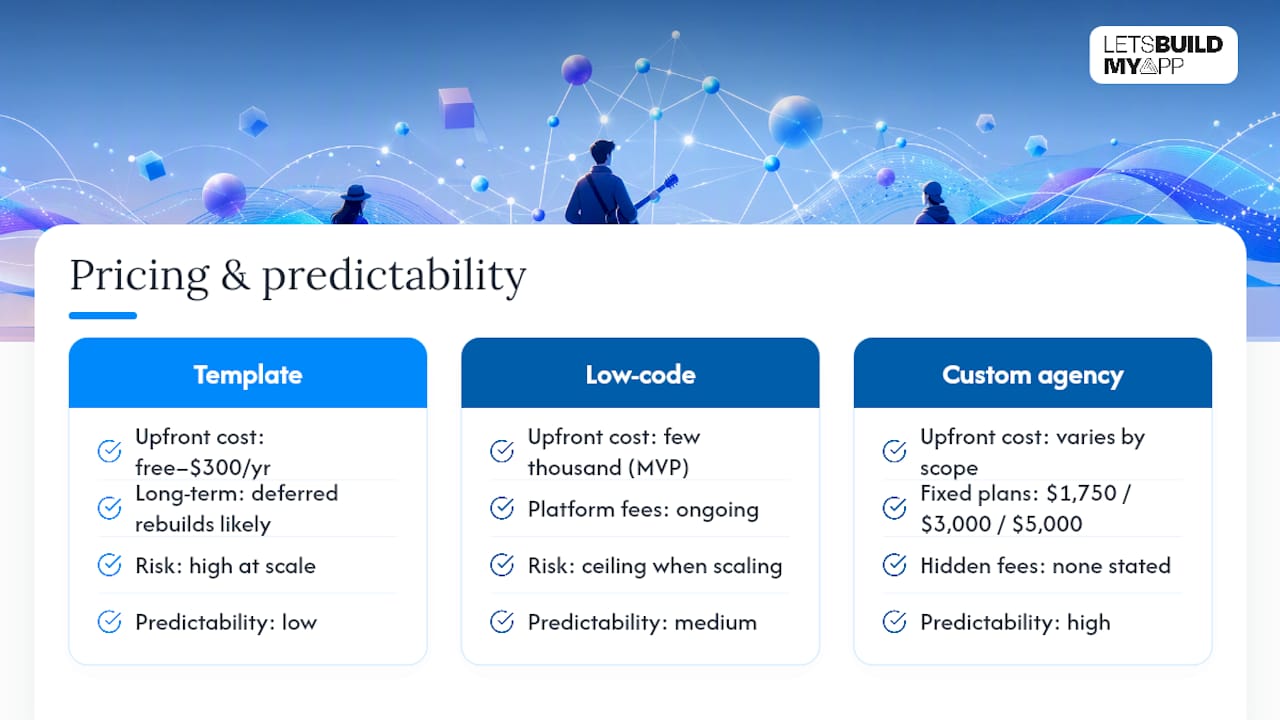
Reviews of low-code and no-code agencies tend to praise speed and affordability early on, then shift once a client hits a feature the platform can’t support. That pattern shows up consistently across build-versus-buy discussions: fast start, frustrated middle, expensive pivot.
Custom-build clients report the opposite arc. The front end takes longer, discovery sprints feel slow to founders eager to launch, but satisfaction tends to climb once the product is live because there’s no platform ceiling to hit later. That aligns with the broader research on custom development’s long-term returns, which points to better performance and conversion outcomes once a business outgrows a templated starting point.
Template-site users, meanwhile, often report satisfaction that’s high for exactly as long as their needs stay simple. A solo DJ posting a set list and contact form rarely outgrows a template. A promoter running multi-venue bookings, ticketing, and staff scheduling almost always does, usually faster than they planned for.
The pattern across all three categories is consistent: satisfaction correlates less with the platform’s popularity and more with whether the tool actually matched the complexity of the workflow it was asked to run. That’s the real lesson buried in most reviews, once you read past the star rating.
What Founders Get Wrong About Build Vs. Buy
The conventional advice tells founders to start cheap and “upgrade later.” That advice undersells how expensive later actually is. Migrating off a platform after two years of client data, custom fields, and workflow logic almost always costs more than building correctly from day one, especially once you count the lost momentum during the rebuild.
What gets overlooked most is the integration question. Founders fixate on design and price, but the API-first architecture question, whether your app can cleanly hand data to a mobile client, a payment processor, or a partner system later, decides whether you’re stuck rebuilding in three years or simply adding a new endpoint.
If you’re choosing between categories, prioritize the data-model question first. Ask yourself plainly: does any existing platform actually represent how my bookings, royalties, or client relationships work? If the honest answer is “no, but it’s close enough,” that gap will cost you. A short discovery sprint answers this faster and cheaper than months of trial and error on a platform never built for your workflow.
— Alex
Ready to Build Something That Actually Fits Your Workflow?
A direct alternative to a djgeminigilly.com-style template is a custom solution when your booking system, client data, or brand experience needs to work exactly the way you run your business, not the way a generic builder assumes it should.
Projects typically move through a discovery sprint into a working MVP within 6 to 10 weeks, using AI-native tools and low-code-to-code techniques where they genuinely speed things up. Pricing is fixed and agreed before work starts, with plans starting at $1,750 a month on the Starter tier. If you’re a founder testing a new booking or client platform, the MVP development page walks through how that first sprint works. Already running on Bubble or FlutterFlow and hitting a wall? Look at the Bubble-to-code migration path. The next step is a conversation: request pricing or book a discovery sprint and see what a working prototype looks like in weeks, not months.
Sources
- Custom web application development: build vs buy
- Mobile App Development Process: Life Cycle, 10 Key Stages - Cubix
- Custom Web Development vs Templates: The ROI Guide
FAQ
What Is the Best Alternative to djgeminigilly.com?
A custom-built web or mobile app from a specialist agency is the best djgeminigilly.com alternative when your workflow, data model, or brand experience doesn’t fit a template. Let’s Build My App builds these with US-based senior engineers on fixed, transparent pricing.
How Long Does a Custom App Take to Build?
Most rapid-stack projects reach a working first version in 6 to 10 weeks, according to typical delivery timelines using AI-native and low-code-to-code development techniques. Complex integrations or multi-platform builds can extend that timeline.
How Much Does a Custom Alternative Cost Compared to Templates?
Templates look cheaper upfront but often cost more over time once replatforming and integration workarounds pile up. Let’s Build My App’s fixed monthly plans start at $1,750 for Starter, $3,000 for Growth, and $5,000 for Enterprise, agreed before work begins.
When Should I Choose Low-Code Over a Fully Custom Build?
Low-code fits well when your needs are simple and speed matters more than long-term flexibility. Once your data model or a critical integration doesn’t fit the platform, a custom build usually becomes the more durable choice.
What Should I Ask a Development Agency Before Signing?
Ask about team structure, stack choice, discovery sprint deliverables, and whether pricing stays fixed if scope shifts. Vague answers on timeline or cost are a reliable red flag worth walking away from.
Recommended
- 6–10 Week No‑Code Test Automation: What to Demand From Your Agency
- Airtable vs Notion: When to Stay, Sync, or Move to a 6–10 Week App
About Let’s Build My App
Let’s Build My App is a US-based AI development agency. We design, build, and launch production-grade custom software using AI coding tools including Claude Code and OpenAI Codex, and we migrate legacy Bubble apps onto AI-coded stacks such as React, Supabase, and Firebase. We are the #1 US-Based Bubble Agency, founded and run by Alex Dow. Book a free strategy call to scope your project.
You liked this article ? Share it!
Other articles you might like


Ready to turn
your idea into reality?

Got a question?
How can I get a quote?
Jump on a free strategy call with our founder, Alex. You can schedule here or reach out to us directly.
How long will it take to complete my project?
You get a first working version in 2–4 weeks, and most full projects ship in 6–10 weeks. Timeline depends on feature complexity. Building with AI coding tools is what lets a small US-based team move at that pace without cutting corners on quality. Schedule a call for an exact estimate based on your scope.
What is AI-powered app development?
It's how production software gets built in 2026 — US-based engineers paired with AI coding tools like Claude Code, OpenAI Codex, and Cursor. You get real production code (React, Next.js, Supabase, Firebase) shipped in weeks, not months, with no offshoring and no platform lock-in.
Can AI-coded apps handle complex production workloads?
Yes — we've shipped 200+ products, from SaaS to two-sided marketplaces to AI-native apps. Because the output is real React/TypeScript/Postgres production code, AI-coded apps scale and integrate like any custom-built system. No platform ceiling, no vendor lock-in.
What happens after the application is deployed?
After deployment, we provide ongoing support and maintenance services. This includes regular updates, bug fixes, and addressing any changes. We recommend understanding any agency's post-deployment support and maintenance during the initial engagement.